Brussels is one of Europe’s most walkable capitals. The historic centre (Pentagon) is compact, with most major attractions around Grand Place, and walking times depend on where you are heading. This walking in Brussels guide for 2026 covers the best self-guided walking routes, pedestrian safety tips, cobblestone footwear advice, and how to plan a perfect Brussels walking day.

Why Walking in Brussels Is the Best Way to See It
Walking in Brussels works because:
- Compact historic core: The Pentagon is compact, with most attractions clustered around Grand Place; walking times depend on where you are heading.
- Pedestrianised streets: The streets immediately around Grand Place (Rue des Bouchers, Rue Charles Buls) are pedestrian-only.
- Free. The best Brussels experiences (Grand Place, Comic Strip Trail, Sablon antique browsing, Marolles flea market) are all walking-only.
- Photogenic at every turn: Brussels rewards slow walkers more than rushed sightseeing.
- Free walking tours operate daily from Grand Place.
Walking in Brussels Guide: Top 5 Self-Guided Routes
1. Historic Centre Walk (3 km, 2 hours)
Grand Place → Manneken Pis → Galeries Royales Saint-Hubert → Cathedral of Saint Michael → Mont des Arts → Royal Palace exterior → back to Grand Place. The standard first-day Brussels walk.
2. Comic Strip Mural Trail (5-6 km, 3-4 hours)
60+ comic-character murals across the Pentagon. Free self-guided walk; pick up the official map at any tourist office. See our Brussels street art guide.
3. Sablon to Marolles (2 km, 90 minutes)
Notre-Dame du Sablon church → Petit Sablon garden → Pierre Marcolini and Wittamer chocolatiers → downhill via Rue de l’Hôpital → Jeu de Balle flea market → Rue Blaes vintage shops. See our Sablon Brussels guide.
4. Art Nouveau Walking Tour (4-5 km, 3 hours)
Maison Horta Museum → Hôtel Tassel → Avenue Louise to Hôtel Solvay → Saint-Gilles via Maison Hannon. See our Art Nouveau Brussels tour.
5. Avenue Louise to Bois de la Cambre (3 km, 90 minutes)
Place Louise → designer-boutique strip → Hôtel Solvay → Bois de la Cambre forest park with rowboat lake. Pleasant in spring and autumn.
Walking in Brussels Guide: Practical Tips
Footwear
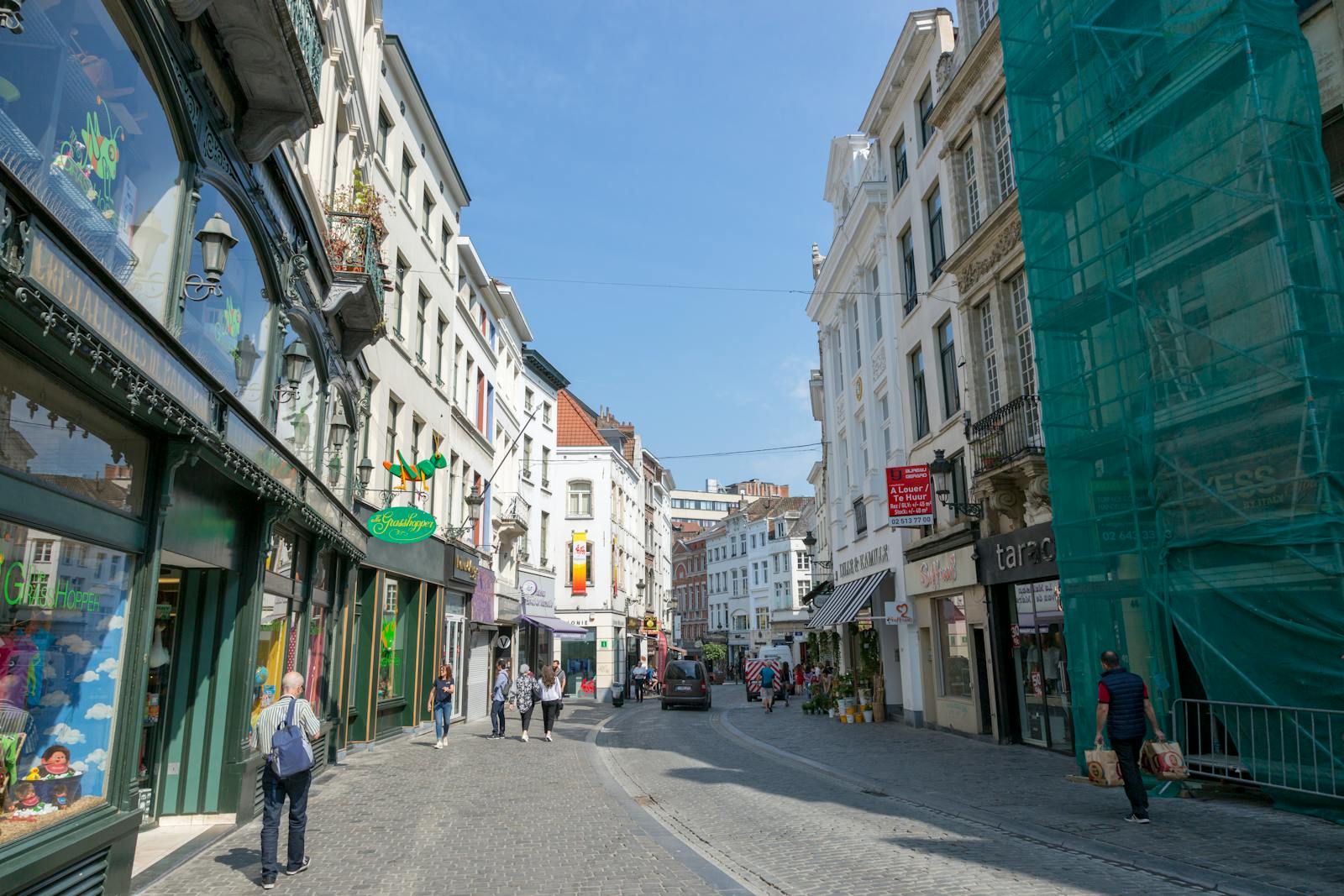
Brussels is cobblestone city. Comfortable walking shoes are essential. Stiletto heels are punishing on the Pentagon’s medieval pavement.
Weather
Brussels sees rain on about 190 days a year. Always carry a compact umbrella; consider a waterproof jacket regardless of season.
Distance Realism
Brussels is compact, but cobblestones and hills slow your pace, so allow extra time on longer walks and wear shoes with a solid sole.
Hills
Brussels has a notable upper-town/lower-town divide. Grand Place sits in the lower town. The Mont des Arts, Sablon, Royal Quarter, and Avenue Louise areas are uphill. Most walks involve some climbing.
Safety
Generally safe day and night in central neighbourhoods. Standard precautions:
- Watch for pickpockets in Grand Place and Rue des Bouchers crowds.
- Avoid Brussels-Midi area after dark.
- Cars are required to yield at unmarked pedestrian crossings; still look both ways.
Free Walking Tours
Brussels Greeters runs free volunteer-led walking tours from Grand Place. Brussels by Foot offers paid 90-minute heritage walks (€15-€20). Multiple Sandeman’s free walking tours operate (tip-based).
Walking in Brussels Guide: Mont des Arts and Mountain Views
The Mont des Arts terraced gardens between Grand Place and the Royal Quarter offer Brussels’ best central viewpoint. Walk up via:
- Rue Cardinal Mercier: The classic ascent.
- Rue Ravenstein: Past the Bozar Centre for Fine Arts.
- Rue de la Madeleine: The most direct path from Grand Place.
The Mont des Arts itself is free to walk; the terraces have benches for resting.
Walking in Brussels Guide: Pedestrian Quarters
The pedestrianised “Boulevard Anspach Piétonnier” runs from Bourse north to De Brouckère and Place de Brouckère. Created in 2015, it’s one of Europe’s largest urban pedestrian zones. Major restaurants, bars, and shops; busy on weekends.
The streets immediately around Grand Place (Rue des Bouchers, Petite Rue des Bouchers, Rue de l’Etuve, Rue Charles Buls) are pedestrian or near-pedestrian. Best for slow walking.
Walking in Brussels Guide: Accessibility
Brussels’ historic centre is challenging for wheelchairs and mobility-limited travellers due to cobblestones. The newer pedestrianised areas (Boulevard Anspach) are smoother. Many metro stations have lifts; older central stations have stairs.
Tactile and audio crossings are available at major intersections. Pedestrian crossing signals follow Belgian standards.
Walking in Brussels Guide: Quick Reference
| Walk | Distance | Time | Highlight |
|---|---|---|---|
| Historic Centre | 3 km | 2 hours | Grand Place + sights |
| Comic Strip Mural Trail | 5-6 km | 3-4 hours | 60+ comic murals |
| Sablon to Marolles | 2 km | 90 min | Antiques + flea market |
| Art Nouveau | 4-5 km | 3 hours | Horta buildings |
| Avenue Louise to Bois de la Cambre | 3 km | 90 min | Boulevard + forest |
Walking in Brussels guide: Real Traveller Scenarios
Three specific Walking in Brussels guide scenarios with tailored advice — examples drawn from common trip patterns:
Scenario 1: First-time weekend visitor (Friday evening – Sunday)
- Friday evening arrival. Hit Grand Place for an evening Belgian beer; metro back to hotel.
- Saturday full day: Tap a contactless card for unlimited transport once you hit the €8.50 daily cap. Cover Grand Place + Magritte + Royal Quarter + Mont des Arts.
- Saturday evening: Belgian dinner near Sablon; metro back to hotel.
- Sunday morning: Comic Strip Mural Trail walk (3-4 hours).
- Sunday afternoon: Lunch + Atomium / Mini-Europe via metro Line 6.
- Sunday evening: Train back to airport for evening flight.
- Total transport spend: contactless metro, tram and bus, capped at €8.50 a day, plus the airport train (the fare and the €6.90 airport supplement) each way.
Scenario 2: Business traveller (Tuesday-Thursday)
- Tuesday arrival: Train from Brussels Airport direct to hotel. Hotel-based evening; minimal transport need.
- Wednesday work day: Walk + occasional Uber/Bolt between meetings (€10-€15 across the day).
- Wednesday evening: Client dinner; taxi back to hotel.
- Thursday work day: Same pattern.
- Thursday evening: Train back to airport.
- Total transport spend: ~€60-€80 (taxi/Uber-heavy pattern; cards more efficient than passes for this use case).
Scenario 3: Family with kids (Mon-Fri half-term week)
- Pre-purchase Brussels Card 72h (€59, plus €21.50 for the STIB transport option) covering 49 museums; saves significantly if you’ll visit 3+ museums.
- Use stroller-friendly metro (most newer stations have lifts).
- Combine Mini-Europe + Atomium (1 day) with the Belgian Comic Strip Centre (half day).
- Day trips: Take the train to Bruges or Ghent. Children under 12 travel free with an adult, 12- to 25-year-olds get 40% off, and adults get 30% off at weekends; no second-class single inside Belgium costs more than about €21.
- Total transport spend for 5-day family of 4: €200-€300 depending on pass strategy.
Walking in Brussels guide: Money-Saving Strategies
How to keep Walking in Brussels guide costs down without sacrificing convenience:
- Brussels Card. Pays for itself with 2-3 museum visits — add the STIB transport option (from €9) for unlimited metro, tram and bus.
- Off-peak travel. On weekdays SNCB’s off-peak discounts (before 06:00, 09:00–16:00 and after 18:00) go to Train+ cardholders and groups of four or more; adults aged 26–64 save at weekends instead.
- No Rail Pass. SNCB withdrew its ten-journey cards in October 2025 and nothing replaced them, so ignore older guides that recommend one. Train+ (€6 a month) takes an extra 40% off off-peak and at weekends and caps a journey at €14.
- Weekend fare. Adults aged 26–64 get 30% off SNCB tickets at weekends, singles included.
- Senior discount. Over-65s get 40% off any SNCB ticket, at any time; the old flat-rate senior return was withdrawn in 2025.
- Youth discount. Under-26s get 40% off any SNCB ticket, at any time, with no card to buy.
- 10-journey Brupass. €18.90 on a MOBIB card for 10 rides — under €1.90 a ride if used fully.
- Contactless tap-to-pay. Automatic €8.50 daily cap on STIB transport.
- Walk where possible. The Pentagon historic centre is compact, and walking times depend on where you are heading from Grand Place.
- Avoid taxi airport transfers. About €50 vs a fraction of that by train (about 18 minutes); the train wins on every metric.
Walking in Brussels guide: Common Mistakes to Avoid
Top walking in brussels guide mistakes that catch first-time Brussels visitors and how to avoid each:
- Buying paper single tickets. A paper single costs €2.90 against €2.40 by contactless card, and contactless stops charging at €8.50 a day, below the €9 paper day ticket.
- Not validating single tickets. Tap the ticket at the turnstile validator. Without validation you risk a €107 fine if checked.
- Taking a taxi from Brussels Airport. About €50 vs a fraction of that by train. The train is about 18 minutes; taxi is 30-45 minutes in traffic.
- Lingering at Brussels-Midi station after dark. The immediate area can feel rough — take a taxi or metro straight to your hotel.
- Assuming the Brussels Card covers transport. STIB travel is an optional add-on, and no version of the card covers SNCB trains.
- Underestimating Pentagon walking distance. The historic centre is more compact than most tourists realise — Grand Place to Manneken Pis is 3 minutes’ walk, not a taxi ride.
- Booking advance Eurostar at the wrong time. 3-4 months ahead gets the cheapest fares; 1-2 weeks ahead doubles or triples the price.
- Assuming a day return is cheaper. SNCB fares are priced by distance and the weekend and age discounts apply to singles too, so compare the options on belgiantrain.be before you buy.
- Riding STIB without your ticket visible. Inspectors check tickets randomly; carry it in case.
- Confusing Brussels Charleroi (BRU South) with Brussels Airport (Zaventem). Charleroi is 55 km from Brussels; Zaventem is 12 km. Check your airport carefully before booking flights.
Walking in Brussels guide: Pro Tips Frequent Travellers Rely On
Beyond the basics, regular Brussels visitors use these walking in brussels guide tips to optimise their movement around the city:
- STIB app real-time arrivals. Shows next train/tram/bus at every stop — saves the standing-around-waiting frustration.
- Citymapper for cross-mode routing. Compares walking, metro, taxi, and rideshare options with current real-time data.
- Pre-book Eurostar 3-4 months ahead. The single biggest money-saver on Brussels international travel.
- Use Maelbeek metro station (Lines 1 & 5) instead of Schuman during EU institution rush hours — same European Quarter access with less crowd.
- Last train back checks. Always check the LAST reasonable train back before lingering for dinner at day-trip destinations.
- SNCB app for live train updates. Belgian rail delays well-signposted via the official SNCB app.
- Underground walkway from Brussels-Central to De Brouckère. Saves an outdoor walk on rainy days.
- Underground walkway from Brussels-Midi to nearby hotels. Avoid the immediate-station-area street.
- Senior travellers (65+): 40% off every SNCB ticket, weekdays included; the old €7 senior return no longer exists.
- Brussels Card holders: If you bought the transport option, use it aggressively — it covers every STIB metro, tram and bus, including bus 12 to the airport.
- For combined cards. Plan museum visits to maximise pass value — front-load the first day with several museums.
For more walking in brussels guide pointers, see our Brussels transportation guide and Brussels metro guide.
Walking in Brussels Guide: 5 Hidden Walking Routes Tourists Miss
Beyond the famous Comic Strip Trail and Pentagon historic walk, Brussels hides several lesser-known walking routes worth exploring:
- Senne River buried-river trail: Follow the trail of Brussels’ covered-over Senne river. Markers throughout the Pentagon trace where the medieval waterway flowed before being covered in 1867-1871.
- Marolles vintage district walk: Rue Blaes, Place du Jeu de Balle, antiques shops, vintage clothing, traditional cafés. 3 km loop; 2 hours with stops.
- Saint-Gilles Art Nouveau walking tour: Concentrated Horta and contemporaries in 5 km; 3 hours with photo stops.
- Bois de la Cambre to Forêt de Soignes: Urban park to ancient beech forest. Start at Avenue Louise; walk through Bois de la Cambre into the protected forest. Up to 30 km of cycle and walking paths.
- Anderlecht canal walk: Modern industrial heritage along the Brussels canal toward Anderlecht. 5 km one way; less touristy alternative to Pentagon walks.
Walking in Brussels Guide: Audio-Guided Walking Tour Apps
- visit.brussels official app: Free, multiple themed audio tours including history, art nouveau, comics, food. GPS-triggered narration.
- GuruWalk Brussels: Free walking tours led by local guides — pay what you think the tour was worth at the end.
- SoFreeBrussels: Tip-based tour app with multiple Brussels-themed routes.
- BANAD app: Annual festival’s app includes self-guided art nouveau audio routes throughout the year.
- Action Heroes Tour: Themed history tours focused on Belgian resistance and WWII heritage.
- Detour Audio Tours: Cinematic, story-driven walking tours by Brussels-based writers.
Walking in Brussels Guide: Weather Considerations
Brussels weather affects walking conditions significantly:
- Rain (about 190 days a year): Cobblestones become slippery; bring waterproof shoes with grip. Galeries Royales Saint-Hubert provides covered alternative walking.
- Winter (December-February): Cold but rarely below freezing. Walking still pleasant if dressed appropriately; Christmas markets transform Pentagon.
- Summer (June-August): Pleasant for walking; longer daylight allows evening walks. Hot days uncomfortable on heat-absorbing cobblestones.
- Spring (March-May): Best walking season; mild temperatures, spring blooms across parks.
- Autumn (September-November): Cool and crisp; autumn foliage in parks and along boulevards.
- Wind: Brussels can be windy, especially in autumn; affect walking comfort but rarely problematic.
Walking in Brussels Guide: Themed Walking Tour Operators
- Brussels Greeters: Free volunteer-led walks; locals show their favourite Brussels corners.
- Sandeman’s New Europe: Tip-based 3-hour daily walking tours from Grand Place.
- Brussels Bike Tours: Cycling-focused but also offer walking tours.
- Brussels By Foot: Paid 90-minute heritage walks (€15-€20).
- Detour Audio Tours: Self-guided audio routes through Brussels neighborhoods.
- Brussels Food Tours: Specialty walking tours focused on Belgian food.
- Belgian Beer Tours: Walking tours combined with beer cafés.
Walking In Brussels Guide: Quick Tips Reference
A quick walking in brussels guide tips reference for last-minute Brussels travellers:
- Brussels Card with its STIB transport option is the simplest sightseeing-plus-transport package for visitors staying 1-3 days.
- SNCB app + STIB app on your phone covers all Brussels-area transport ticketing efficiently.
- Cashless transport: Contactless tap-to-pay works at all STIB turnstiles; €8.50 daily cap is automatic.
- Plug type: European Type E (round 2-pin), 230V — bring an adapter if travelling from North America or UK.
- Emergency: 112 (European universal emergency number).
- Wi-Fi: Free Wi-Fi at most cafés, hotels, museums. SNCB trains have WiFi.
- Daily budget: Budget travellers €60-€80/day; mid-range €120-€150; luxury €200-€500.
- Local greeting: “Bonjour” (French) or “Goeiedag” (Dutch); English universally understood in tourist contexts.
For more, see our Brussels first time visitor tips.
Walking In Brussels Guide: Final Practical Notes
One more quick walking in brussels guide practical reminder for travellers:
- Confirm operating hours before relying on any specific timetable — Belgian public transport occasionally adjusts hours for holidays, strikes, or maintenance.
- Keep paper backup of digital tickets for the rare case your phone fails — screenshot QR codes and save as photos.
- Belgian holidays affect transport: Christmas Day, New Year’s Day, Easter Sunday, May 1 (Labour Day), July 21 (National Day), August 15 (Assumption), November 1 (All Saints), November 11 (Armistice) all see reduced service.
- Allow buffer time for ticket buying queues at major stations during peak hours.
If you would rather someone else chose the route and told you what you are looking at, the tip-based tours cover much the same ground on much the same cobbles. Our guide to free walking tours in Brussels covers the operators, the upper-town climb they all include, and what to tip at the end.
Related Brussels Guides
Keep planning with these companion guides:
- Brussels Transport Tickets — Passes & Prices Explained
Useful Resources
- visit.brussels — official tourism office (free downloadable walking maps).
- Comic Strip Trail — official mural trail map.
Frequently Asked Questions
Is Brussels walkable?
Yes — exceptionally so. The Pentagon historic centre is compact, with most attractions clustered around Grand Place, and walking times depend on where you are heading.
How long to walk across central Brussels?
The Sablon and Avenue Louise both lie uphill from the Grand Place, and the European Quarter is to the east. A maps app gives the walking time from your hotel for each leg.
Are Brussels streets pedestrianised?
Yes — the streets immediately around Grand Place are pedestrian-only. The Boulevard Anspach Piétonnier is one of Europe’s largest urban pedestrian zones (since 2015).
What’s the best Brussels walking route?
For first-time visitors: the Historic Centre Walk (3 km, 2 hours). For repeat visitors: the Comic Strip Mural Trail (60+ murals, self-guided) or the Sablon-to-Marolles walk.
Are there free Brussels walking tours?
Yes — Brussels Greeters offers free volunteer-led walks from Grand Place. Sandeman’s runs tip-based free walking tours. Brussels by Foot offers paid 90-minute heritage walks.
What footwear for walking in Brussels?
Comfortable walking shoes — cobblestones are everywhere in the Pentagon. Avoid stiletto heels or thin-sole flats. Waterproof shoes for rainy days.
Final Thoughts
Walking in Brussels guide essentials are simple: comfortable shoes, an umbrella, and patience. The city rewards slow walkers more than rushed sightseeing. For more on Brussels’ walking-friendly neighbourhoods, see our Brussels neighbourhoods guide.