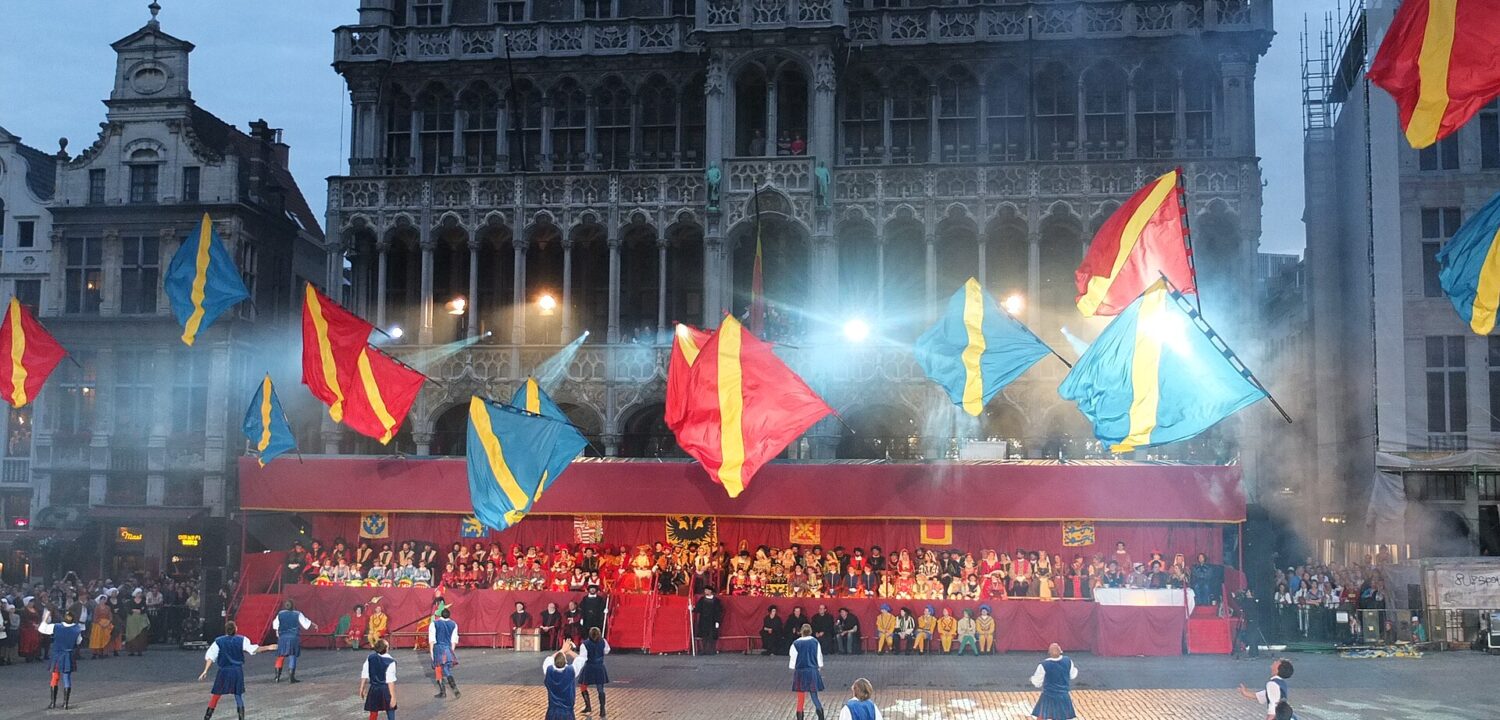
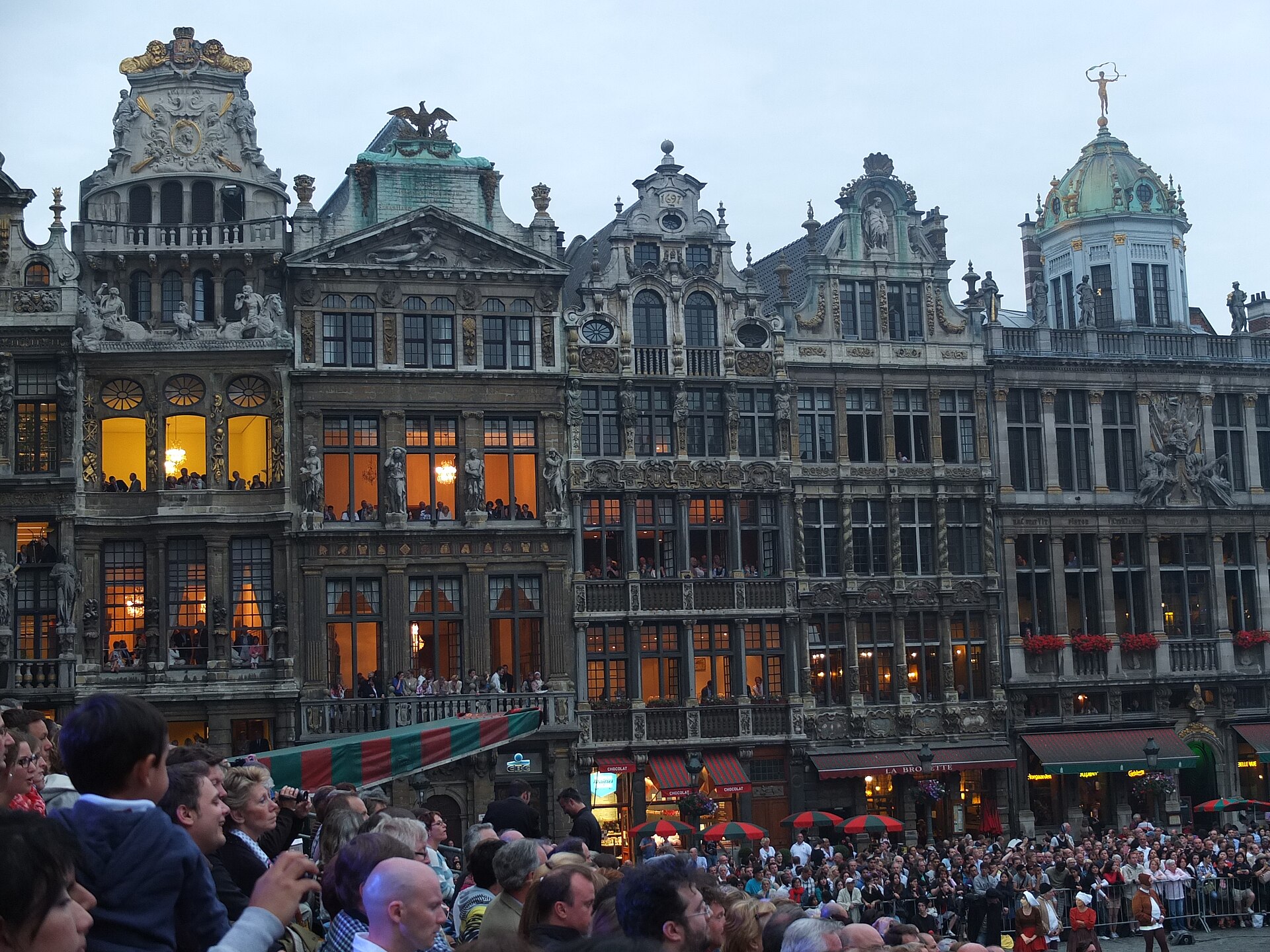
On two July evenings each year, the Grand-Place stops being a square full of people photographing gables and becomes a stage. Banners crack in the air, horses in embroidered caparisons clatter over the cobbles, and an actor playing Emperor Charles V takes his seat in front of the Town Hall to receive the homage of the city. The Ommegang Brussels pageant is part history lesson, part costume parade and part civic party.
This guide explains what the Ommegang actually commemorates, when it happens, what the grandstand tickets cost and whether they are worth it, which parts you can see for free, and how to plan the evening. Dates, prices and timings were checked in November 2026 against the organiser’s site, ommegang.be, and the City of Brussels. The 2026 programme is used throughout as the guide to what to expect in 2027; check ommegang.be for the 2027 dates and ticket sales before you book travel.
When Is the Ommegang?
The Ommegang takes place over two evenings in early July. In 2026 the performances were on Wednesday 1 July and Friday 3 July, with the Sablon festivities running from 1 to 4 July. The organiser publishes each year’s dates on ommegang.be, and that is the place to check for the 2027 dates.
The evening is a sequence rather than a single show. Here is how it ran in 2026, so you can see the shape of it:
| Time (2026) | What happens | Where |
|---|---|---|
| From 12:00 | Renaissance village, market and jousting (jousting until 20:00, village and market until 21:30) | Place du Grand Sablon |
| 19:15 | Crossbow competition of the two guilds | Sablon |
| From 19:30 | Grandstand seating opens | Grand-Place |
| 20:10 | Charles V and the Infante arrive at the Sablon | Sablon |
| 20:40 | The historical procession leaves the Sablon | Through the old town |
| 20:45 to 21:00 | The show on the Grand-Place begins (the organiser’s pages give both times; check your ticket) | Grand-Place |
| 21:00 to 21:15 | The procession passes the cathedral esplanade | Sainte-Gudule |
The practical upshot: the free daytime fun is at the Sablon, the procession winds through the streets in the evening, and the climax is on the Grand-Place after dark. You cannot do all of it in one evening without missing something, which is one reason the event runs twice.
What the Ommegang Commemorates
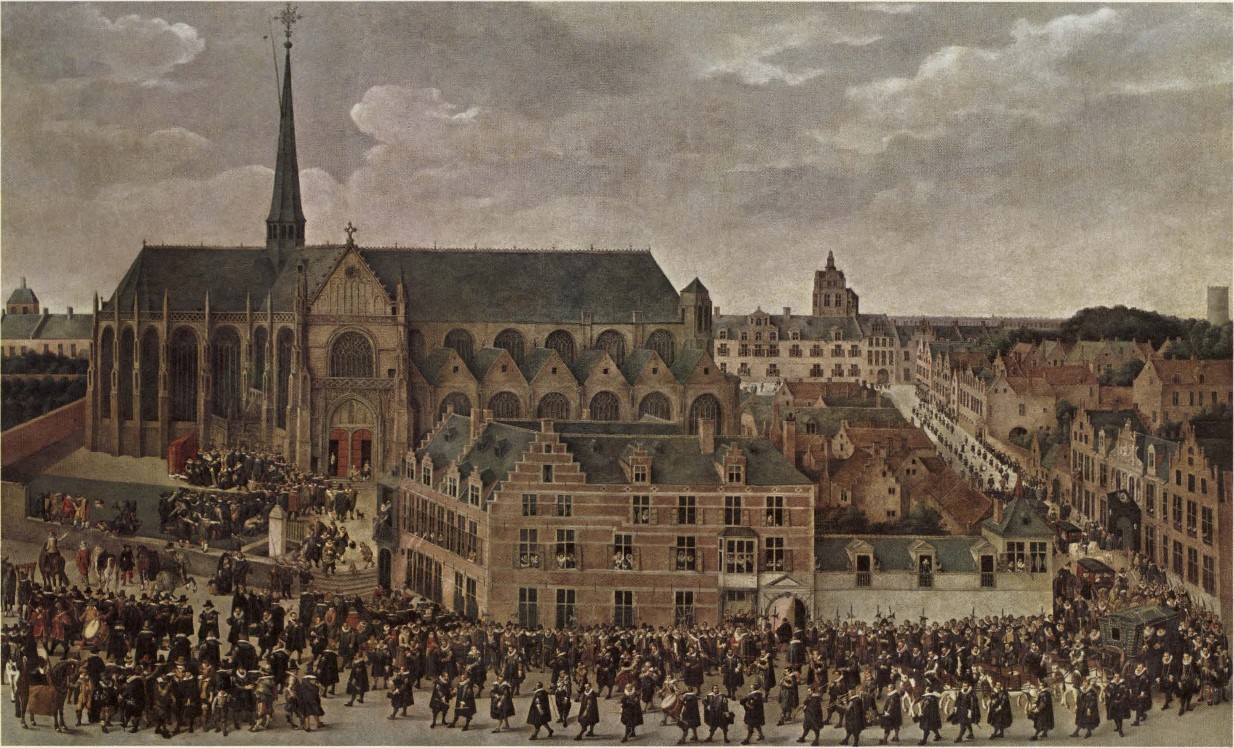
“Ommegang” is an old Dutch word for a procession that walks around something, and the Brussels one has two layers of history stacked on top of each other.
The religious procession
The older layer is a procession in honour of Notre-Dame du Sablon, the Gothic church on the Sablon. The legend, which the organiser dates to 1348, tells of Béatrice Soetkens, a woman from Antwerp who was told in a vision to bring a statue of the Virgin to Brussels and did so by boat. The statue was taken to the chapel of the crossbowmen’s guild at the Sablon, and the procession grew up around it, organised by the Grand Serment des Arbalétriers, the city’s great crossbow guild. That is why the crossbowmen still have a starring role, and why the evening starts at the Sablon rather than on the Grand-Place.
Charles V in 1549
The second layer is the one the modern pageant re-enacts. In 1549 Emperor Charles V attended the Ommegang in Brussels, the organiser gives the date as 2 June, and presented his son, the future Philip II, to the city. The procession that day was described in detail by contemporaries, and those descriptions are what the modern show is built from: the order of the guilds, the nobles, the costumes and the court.
Decline and revival
The procession faded in the 18th century. It was recreated between 1928 and 1930, using the descriptions of the 1549 procession, and staged in 1930 for the centenary of Belgian independence. It has been staged in July in recent decades, and in 2019 UNESCO inscribed it on the Representative List of the Intangible Cultural Heritage of Humanity as “the Ommegang of Brussels, an annual historical procession and popular festival”. The City of Brussels gives the date of the inscription as 11 December 2019. Our guide to Brussels’ UNESCO sites covers the Grand-Place’s own World Heritage listing and the rest.
For the wider story of the city in Charles V’s time, see our history of Brussels.
Grandstand Tickets: Prices and Which Seats
The show on the Grand-Place is ticketed, with grandstands built around the square. In 2026 the organiser listed these categories:
| Seat (2026) | Position | Price |
|---|---|---|
| Tribune B | In front of the Town Hall | €59 |
| Tribune H | In front of the House of the Dukes of Brabant | From €59 |
| VIP | Covered seats | €89 |
A printed programme cost €5 on the night in 2026. Prices for 2027 go up on ommegang.be with the ticket sales, so treat the table as the order of magnitude rather than a quote.
Two rules worth knowing before you buy. The show goes ahead in the rain, and umbrellas are not allowed in the stands, so bring a waterproof jacket rather than relying on cover. And the start time printed on your ticket is the one that matters; the organiser’s own pages gave both 20:45 and 21:00 for 2026.
Are the grandstand seats worth it?
If you have come to Brussels for the Ommegang, yes. The show is staged for the stands: the procession files into the square, the court takes its place, and the flag-throwing, horsemanship and set-pieces play out in front of the seated audience. From the edge of the square behind barriers you see heads and the tops of banners.
If you are simply in Brussels that week and curious, the free parts give you most of the atmosphere for nothing. Spend the afternoon at the Sablon, watch the crossbowmen, then find a spot along the procession route in the evening. You will see the costumes, the horses and the music up close, which the grandstands, set back from the action, do not always give you.
The Free Parts
A lot of the Ommegang costs nothing. According to the City of Brussels, you can follow the procession for free outside the stands, and the Sablon festivities have free entry.
The Sablon festivities
For four days around the performances, the Place du Grand Sablon becomes a Renaissance village. In 2026 it ran from 1 to 4 July, from noon, with a market, costumed demonstrations and jousting until 20:00, and the village and market open until 21:30. On the two performance evenings the crossbow competition between the guilds took place at 19:15. It is a good place to bring children: there is space, there are horses, and nobody minds if you leave after twenty minutes. Our Sablon guide has the cafés and chocolate shops around the square.
The procession through the streets
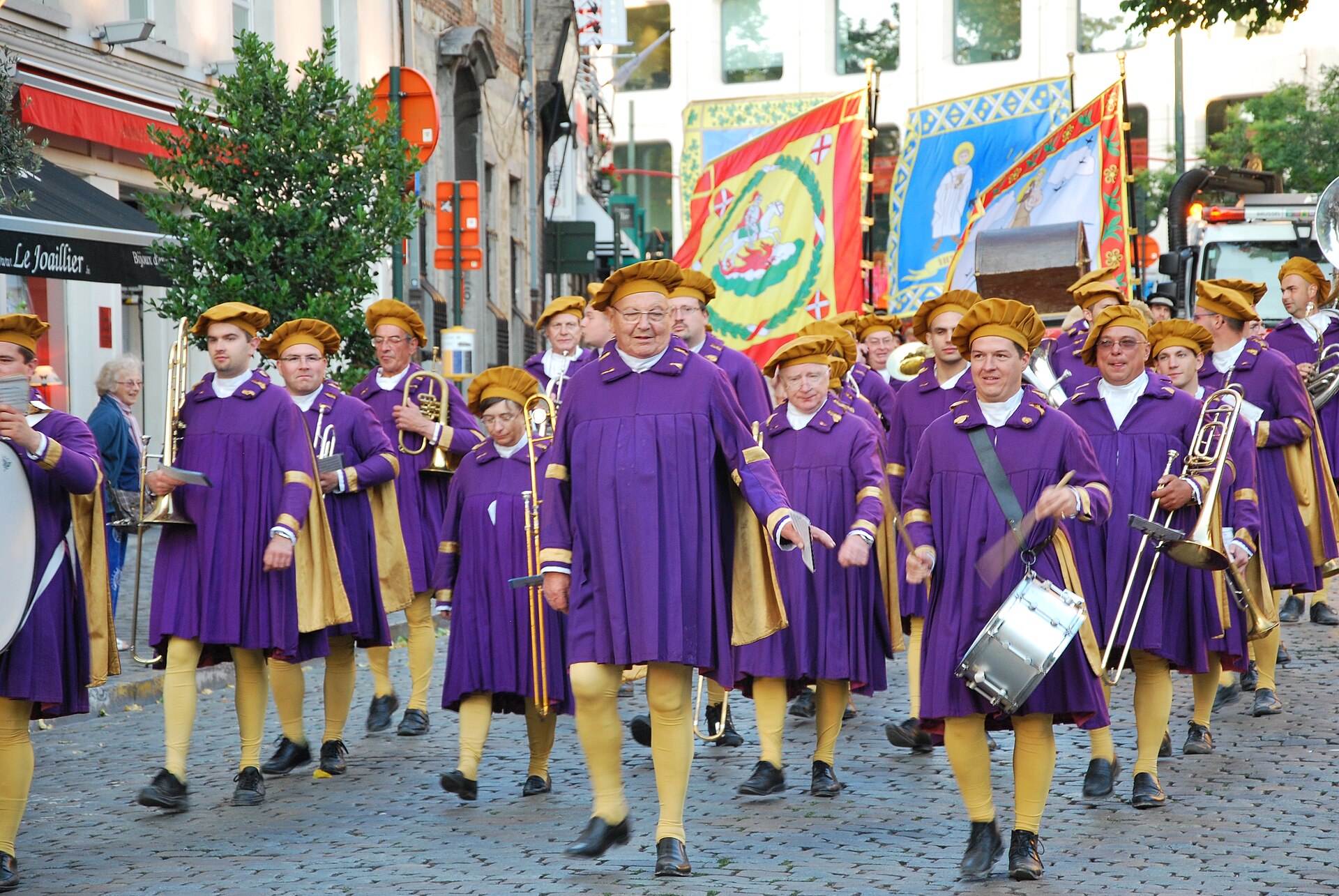
In 2026 the procession left the Sablon at 20:40 and took a long loop through the old town to the Grand-Place. The organiser’s route ran down the Rue des Sablons and the Rue Lebeau, across the Place de la Justice and up through the Rue de l’Hôpital and the Place Saint-Jean, then on via the Rue Duquesnoy to the esplanade of the Cathedral of St Michael and St Gudula, which it passed between 21:00 and 21:15. From there it came back down the Rue de la Montagne and the Marché aux Herbes, crossed the Boulevard Anspach, and approached the Grand-Place via the Rue du Midi, the Rue des Grands Carmes, the Rue de l’Étuve and the Rue Charles Buls.
The cathedral esplanade is a good free viewpoint, wider and less cramped than the lanes near the Grand-Place. Get there a good half hour before the procession is due. The streets near the Manneken Pis and the Rue de l’Étuve fill up fastest, because everyone heading for the square is funnelled into them.
Routes and timings can change from year to year, so check the 2027 route on ommegang.be before you pick your spot.
What You Will See
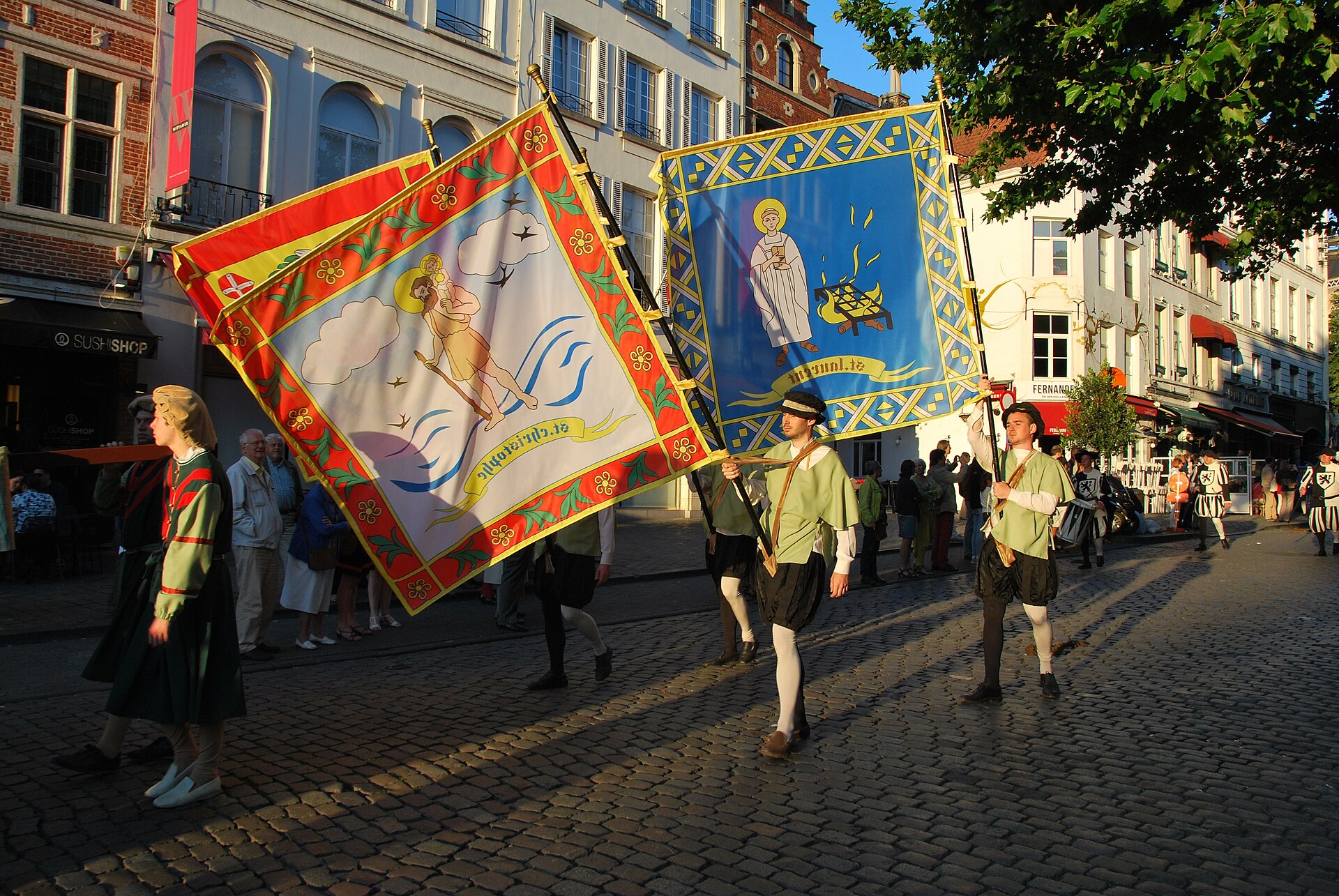
The cast is large: the organiser’s own pages describe it as anything from about 1,200 to some 1,400 costumed participants. Among the things to look out for:
- Charles V and his court. The emperor and his son Philip, the Infante, surrounded by nobles in velvet and fur.
- The guilds and the crossbowmen. The trades of 16th-century Brussels in their colours, with the two crossbow guilds given pride of place.
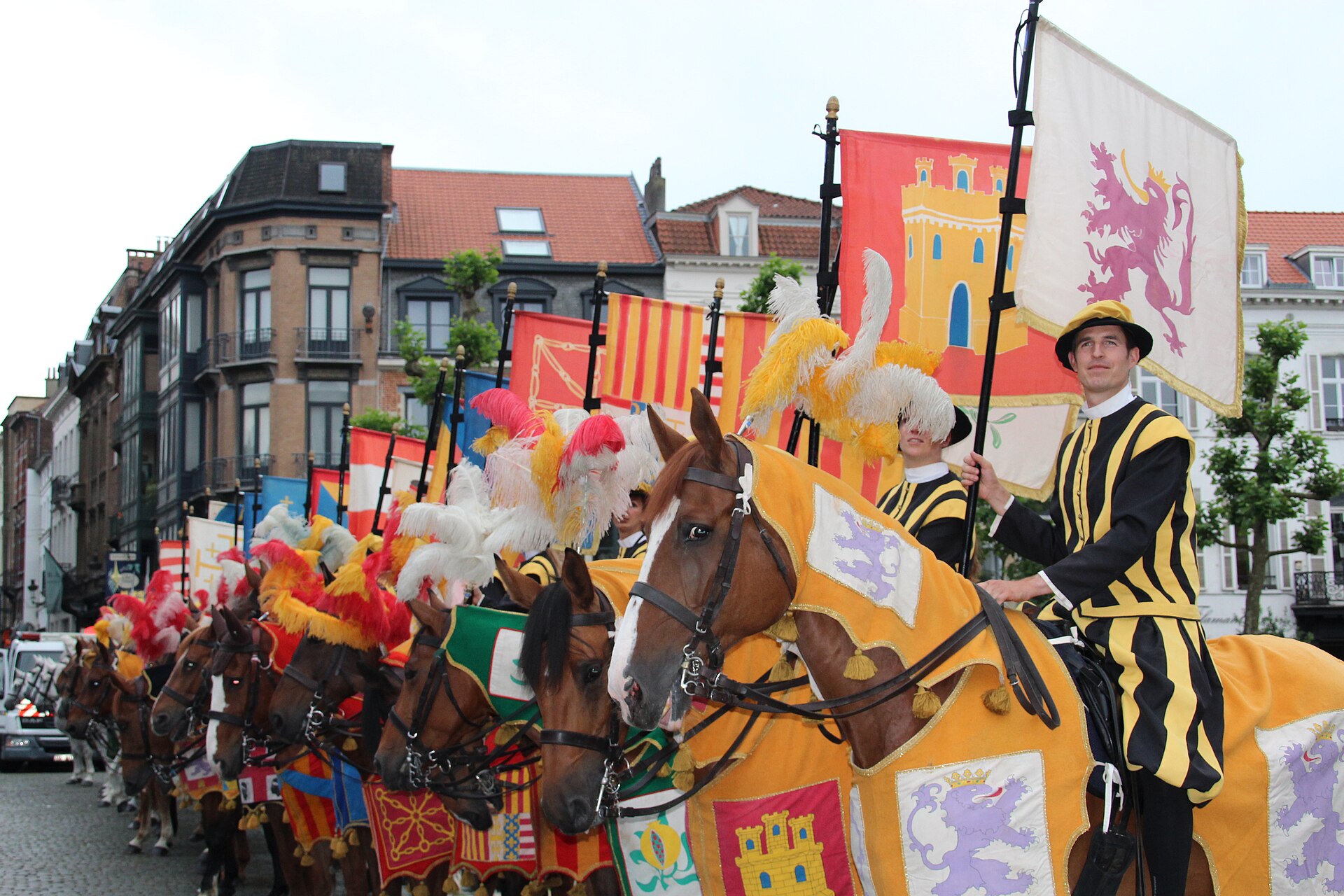
- Horses. Riders in Renaissance costume on caparisoned horses, which are one of the highlights for children.
- Flag-throwers. The banners spun, tossed and caught in formation on the Grand-Place are the most photographed part of the show.
- Giants and stilt-walkers. Processional giants, including the Brewers’ Giant, and stilt-walkers.
Each year also has its own flavour. In 2026 Japan was the country of honour, marking 160 years of relations with Belgium, with a Japanese pre-show before the main performance. Check ommegang.be to see what 2027 brings.
Planning Your Ommegang Evening
A simple plan
- With grandstand tickets: spend the late afternoon at the Sablon, eat early nearby, and walk down to the Grand-Place for when seating opens. It is a short walk downhill.
- Without tickets: Sablon in the afternoon, the crossbow competition, then the cathedral esplanade for the procession. Afterwards, the Grand-Place stays lively even if you cannot see the show itself.
- With children: the Sablon in the daytime is the best bit. The evening runs late, and the procession only reaches the Grand-Place after 21:00.
Eating and sleeping
Restaurants around the Grand-Place and the Sablon are busy on Ommegang nights, so book dinner ahead if you want a table rather than a waffle. Our guide to the best restaurants in Brussels has options in both areas. If you want to walk back to bed afterwards, a hotel in the centre makes a big difference; see our pick of hotels near the Grand-Place, and book early for the first week of July.
Weather and what to bring
July in Brussels averages 18.7°C as a monthly mean (Royal Meteorological Institute, Uccle, 1991–2020), and evenings on the Grand-Place can feel cool once the sun has gone. Showers are common. Bring a light waterproof, because umbrellas are not allowed in the stands, and a layer for after dark.
Accessibility
The grandstands and the cobbled streets of the old town are not easy for wheelchair users. The organiser publishes practical and mobility information on ommegang.be; contact them before you book if you need an accessible seat. Our guide to wheelchair-accessible Brussels covers the city more widely.
Combine It With
The Ommegang falls at the start of the summer season, and it pairs well with a few other things in early July:
- The Royal Palace. The palace has opened to the public in summer; in 2026 the opening ran from 3 July to 16 August, at €10 for ages 13 and over, so check the City of Brussels for 2027. See our Royal Palace guide.
- The rest of summer. The national holiday on 21 July and the city’s other summer festivals follow close behind in the calendar. Our guide to Brussels summer festivals has the lot.
- The Grand-Place by day. Come back the morning after to see the square without the stands and the crowds; our Grand-Place guide explains the guildhouses you were looking at.
Related Brussels Guides
- Brussels Events Calendar
- Brussels Summer Festivals
- Grand-Place Brussels Guide
- Sablon Brussels Guide
- Belgian Traditions and Customs
- Brussels Churches and Cathedrals
- Brussels Month by Month
Useful Resources
- Ommegang: dates, tickets and the programme
- Ommegang practical information: seating, times and rules
- City of Brussels: Ommegang
- UNESCO: the Ommegang of Brussels
Frequently Asked Questions
When is the Ommegang in 2027?
It takes place over two evenings in early July; in 2026 the performances were on Wednesday 1 and Friday 3 July. Check ommegang.be for the 2027 dates and ticket sales.
How much are Ommegang tickets?
In 2026, grandstand seats in front of the Town Hall (Tribune B) cost €59, seats in front of the House of the Dukes of Brabant (Tribune H) started at €59, and covered VIP seats cost €89. The 2027 prices come out with the ticket sales on ommegang.be.
Can you watch the Ommegang for free?
Yes, partly. The Sablon festivities, with the Renaissance village, market, jousting and crossbow competition, are free, and you can watch the procession for free along its route through the old town. The show on the Grand-Place itself is ticketed.
What does the Ommegang commemorate?
It re-enacts the procession attended by Emperor Charles V in Brussels in 1549, when he presented his son, the future Philip II, to the city. It grew out of an older religious procession for Notre-Dame du Sablon, organised by the crossbowmen’s guild.
Is the Ommegang a UNESCO event?
Yes. UNESCO inscribed the Ommegang of Brussels on the Representative List of the Intangible Cultural Heritage of Humanity in 2019.
Does the Ommegang go ahead in the rain?
Yes. The show goes ahead in the rain, and umbrellas are not allowed in the grandstands, so bring a waterproof jacket.
How long has the modern Ommegang been running?
The modern pageant was recreated between 1928 and 1930 from descriptions of the 1549 procession and first staged in 1930, for the centenary of Belgian independence.
Photo Credits
Archduchess Isabella at the crossbow guild’s feast before the Sablon church: AntoonSallaertIsabella, workshop of Antoon Sallaert, public domain, via Wikimedia Commons.
Musicians in the Ommegang procession: Ommegang in Brussels 2014-07-01 06 by Zorro2212, CC BY-SA 4.0, via Wikimedia Commons.
Banner bearers in the Ommegang procession: Ommegang in Brussels 2014-07-01 07 by Zorro2212, CC BY-SA 4.0, via Wikimedia Commons.
The Grand-Place on an Ommegang evening: Ommegang2 by Christophe Degryse, CC BY-SA 4.0, via Wikimedia Commons.
Final Thoughts
The Ommegang is a reconstruction, and it does not pretend otherwise. What makes it work is that Brussels takes it seriously: the crossbowmen still competing at the Sablon, the whole old town given over to it for two evenings. Buy a grandstand seat if the pageant is the point of your trip. Otherwise, spend a free afternoon at the Sablon, catch the procession at the cathedral, and let the Grand-Place’s noise tell you where the show is. Either way, check ommegang.be for the 2027 dates and pack a raincoat, not an umbrella.