Belgium is small enough that you can eat breakfast in Brussels, spend the morning in a Flemish canal city, be in a French-speaking river valley by mid-afternoon and get back for dinner. It is 300 kilometres from the North Sea to the Luxembourg border, the railway network is one of the densest in the world, and no city you are likely to want to see is more than about an hour and a half from the capital. That is the single most useful fact in any Belgium travel guide: the country is engineered for a base-and-radiate trip, and Brussels sits in the middle of it.
This guide is about the country rather than the capital. It covers how Belgium is put together — the language regions, the railway, the regions worth your time — and how to structure a trip that uses Brussels as its hub. Prices and journey times were checked in September 2026 and are written for travel through 2027; treat the figures as the right order of magnitude rather than a quote, particularly the rail fares, because Belgian Railways spent late 2025 and early 2026 rebuilding its entire ticket range.
Belgium at a Glance
| The short version | |
|---|---|
| Size | About 30,700 km² — roughly the size of Maryland, or half of Ireland |
| Languages | Dutch in Flanders, French in Wallonia, both in Brussels, German in a small eastern strip |
| Currency | Euro. Cards accepted almost everywhere; carry a little cash for markets |
| Getting around | Rail. Frequent, all-day, no reservations needed on domestic services |
| Longest domestic hop | Brussels to the coast or the deep Ardennes, both around 1½–2½ hours |
| Best base | Brussels for a first trip; Ghent or Antwerp if Flanders is the whole plan |
| Days needed | 4 for a taste, 7 for a proper first trip, 10+ to include the Ardennes properly |
| Peak season | July–August and the December markets; April–June and September are better |
Why Brussels Works as a Base — and When It Does Not
Brussels is not the prettiest city in Belgium and nobody who lives there would claim otherwise. What it is, is central, well connected and cheaper to sleep in than Bruges. Those three things together make it the default base for a first trip, and the case is stronger than it first appears.
The geography argument
Every main line in the country runs through Brussels, because the north–south junction under the city links Brussels-Midi/Zuid, Brussels-Central and Brussels-Nord/Noordstation into one spine. From that spine you reach Ghent in about half an hour, Leuven in twenty-five minutes, Antwerp in thirty-five to fifty-five depending on the service, Bruges and Namur in about an hour, and Ostend or Knokke on the coast in an hour and a half. Trains run at least hourly on all of these, usually twice an hour, all day, with no reservation and no advance-booking game to play. You can decide over breakfast where you are going.
The second argument is money. Hotel rates in Bruges in July are not a friendly number, and Ghent in a festival week is worse. Brussels is a business city, which means its hotel stock is priced for weekdays and discounts hard at weekends — the inverse of the leisure cities. Our guide to where to stay in Brussels covers which districts actually work, and Brussels on a budget is worth reading before you book anything.
When to move base instead
Be honest about the limits. Basing in Brussels stops making sense in three situations.
- If you only want Flanders. Ghent and Antwerp are both better bases for the Flemish art cities than Brussels is, and Ghent in particular is a genuinely lovely place to come back to in the evening. If your trip is Bruges, Ghent, Antwerp and Mechelen, base in Ghent and skip the capital.
- If you want the Ardennes. The southeast is not day-trip country. Bastogne, Bouillon and the Semois valley need at least one overnight, and preferably a car.
- If you want the coast in season. An hour and a half each way eats a beach day. Sleep in Ostend or Knokke for two nights instead.
Everything else — the art cities, the Meuse, Flanders Fields, Leuven, Mechelen, even Luxembourg City — works comfortably from Brussels. The eleven routes covered in our day trips from Brussels guide are the practical proof of it.
The Three Belgiums
Belgium is a federal country made of language communities, and understanding that structure explains almost everything you will notice on the ground: why the road signs change halfway through a journey, why the same city has two names, why the beer culture in Antwerp feels different from the beer culture in Liège.
Flanders
The northern half, Dutch-speaking, flat, densely built and prosperous. This is where the famous cities are: Bruges, Ghent, Antwerp, Mechelen, Leuven. It is also where most of the tourism infrastructure is, where the museums keep the longest hours, and where English is spoken most widely — Flemish schools teach it from an early age and Flemish television does not dub. Signage is in Dutch only once you are outside Brussels, so Gent, Brugge, Antwerpen, Mechelen, Leuven, Oostende.
Wallonia
The southern half, French-speaking, hillier, greener and much less visited. Namur, Liège, Dinant, Tournai, Mons and the whole Ardennes are Walloon. It is quieter, cheaper, and the pace is slower in a way that is either restorative or frustrating depending on your mood. English is less widely spoken here than in Flanders — not absent, but you will use more French. Signage is French only: Namur, Liège, Dinant, Mons, Tournai.
Brussels
Officially bilingual, geographically inside Flanders, culturally its own thing, and in practice majority French-speaking with a large international population. Every street sign, station name and metro announcement is in both languages, which is why the capital’s place names come in pairs: Brussels-Midi is Brussel-Zuid, Sainte-Catherine is Sint-Katelijne, Ixelles is Elsene, Schaerbeek is Schaarbeek. Our guide to languages spoken in Brussels untangles this properly.
The German-speaking Community
A small strip along the eastern border around Eupen and Sankt Vith, around 78,000 people, with its own parliament. You will not stumble into it by accident, but it is a genuine third official language and worth knowing exists.
Language etiquette in one paragraph
Open in English rather than guessing. Using French in Flanders or Dutch in Wallonia can land badly in a way that English never does — English is neutral ground and is understood as a courtesy rather than a political statement. Learn dank u wel and merci, use whichever matches where you are standing, and you will be fine. Our page on Belgian traditions and customs goes further into what is expected socially.
Getting Around: The Railway Is the Country
Belgium has one of the densest rail networks on earth and it is the only transport decision most visitors need to make. Domestic trains are turn-up-and-go: no reservations, no seat allocation, no advance-purchase pricing on standard tickets. You buy, you board.
Journey times from Brussels
| Destination | Time from Brussels | Frequency |
|---|---|---|
| Leuven | ~25 min | Several an hour |
| Ghent (Gent-Sint-Pieters) | ~30 min | Twice an hour or better |
| Mechelen | ~25 min | Several an hour |
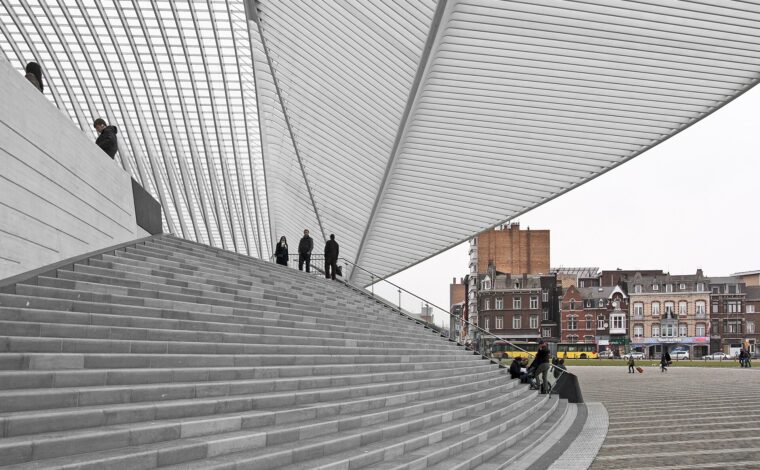
| Antwerp (Antwerpen-Centraal) | ~35–55 min | Twice an hour or better |
| Bruges | ~1 hour | Twice an hour |
| Namur | ~1 hour | Twice an hour |
| Liège-Guillemins | ~1 hour | Twice an hour |
| Ostend / Knokke | ~1½ hours | Hourly, direct |
| Ypres | ~1¾ hours | Hourly, usually a change |
Tickets and passes — read this before you buy
Belgian Railways rebuilt its fare structure between October 2025 and early 2026. The old Standard Multi, Youth Multi, Local Multi and ten-identical-journeys cards were withdrawn on 15 October 2025 and replaced with a new range built around automatic discounts. Any guide still recommending a Standard Multi is out of date, and there are a lot of them.
The Rail Pass, the ten-journey card that used to be the best-value product for a visitor, went with them, and nothing replaced it. Every ticket is now priced by distance, with a second-class single capped at about €21, 30% off at weekends for adults aged 26–64 and 40% off at any time for under-26s and over-65s. Children under 12 travel free with a paying adult, and four to fourteen people travelling together get the mini-group fare: 40% off off-peak and at weekends.
The honest caveat: because the fare system moved recently, price your actual journeys on belgiantrain.be before you travel. If you are making several longer trips, Train+ (€6 a month) takes an extra 40% off off-peak and at weekends and caps any journey at €14.
Trams, buses and the Kusttram
Local transport is run by three regional operators: De Lijn in Flanders, TEC in Wallonia and STIB/MIVB in Brussels. Tickets do not cross between them, which surprises people. In practice you will barely need buses — Belgian city centres are small and walkable — with one glorious exception.
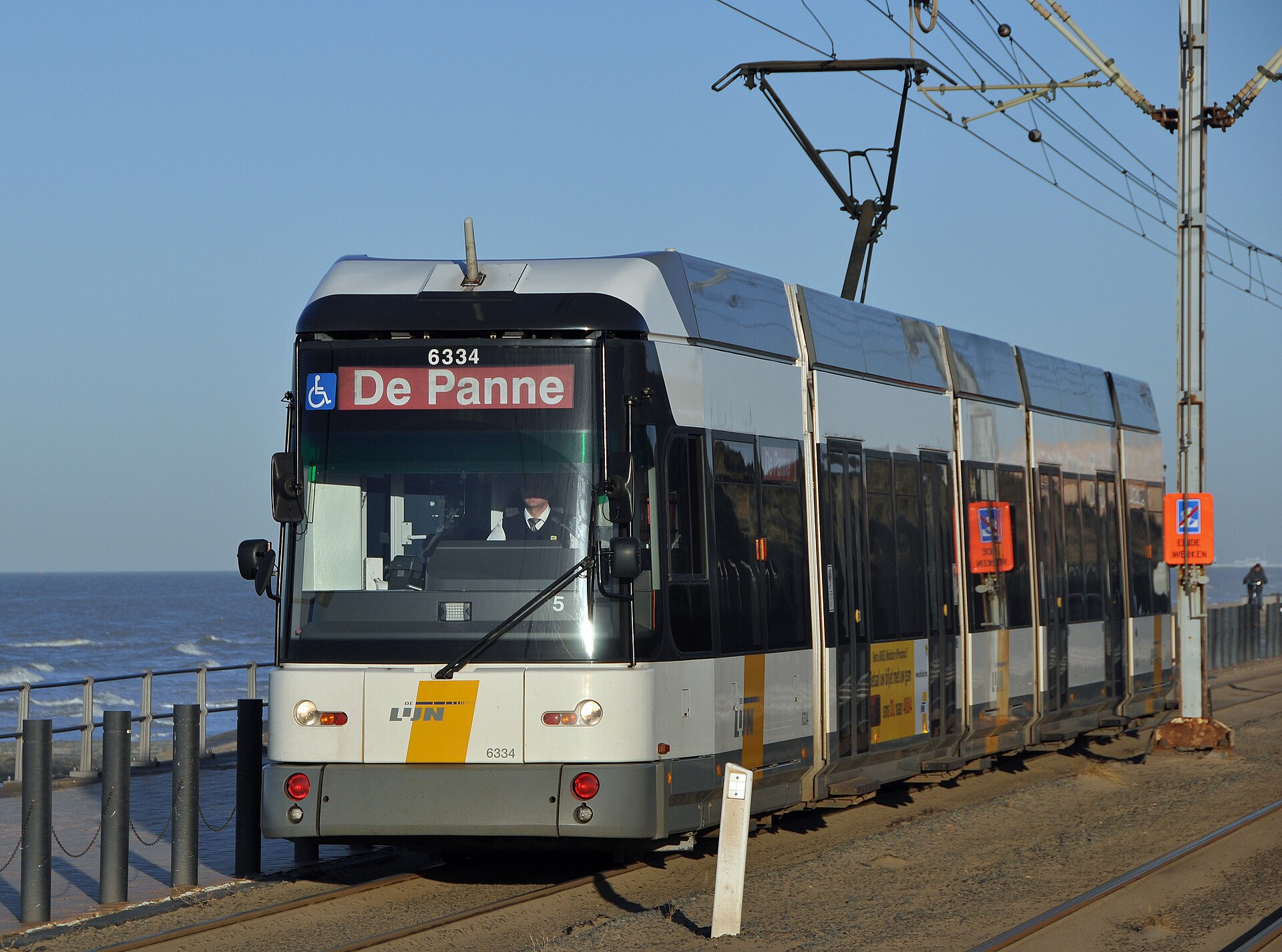
The Kusttram runs the entire 67-stop length of the Belgian coast, from De Panne near the French border to Knokke near the Dutch one, and is the longest tram line in the world. It is a De Lijn service, it takes about two and a quarter hours end to end, and it is the single most enjoyable piece of public transport in the country. Ride a section of it even if you have no particular destination.
When a car is worth it
For the Flemish cities, never — you will pay for parking and gain nothing. For the Ardennes, yes, and it is close to essential if you want the villages rather than the towns. For Flanders Fields, a car or a booked tour makes a real difference, because the cemeteries and memorials are scattered across farmland with no useful bus service. Otherwise the train wins on time, cost and stress.
Where to Go
The Flemish art cities
Bruges, Ghent, Antwerp, Mechelen and Leuven are the backbone of most first trips, and each has a distinct character rather than being variations on a theme.
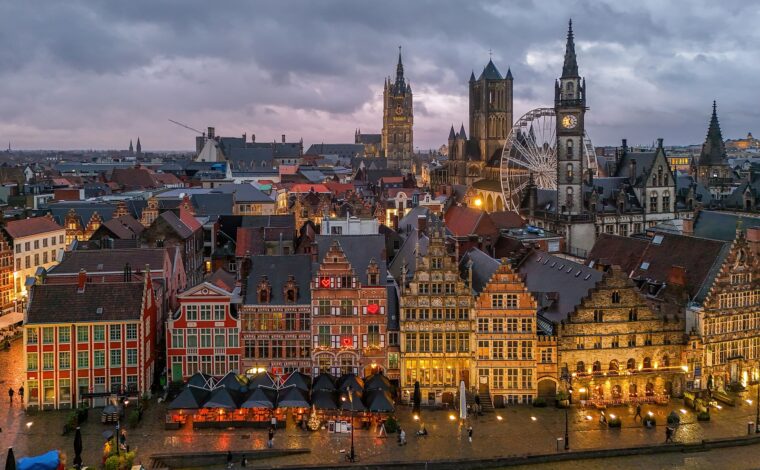
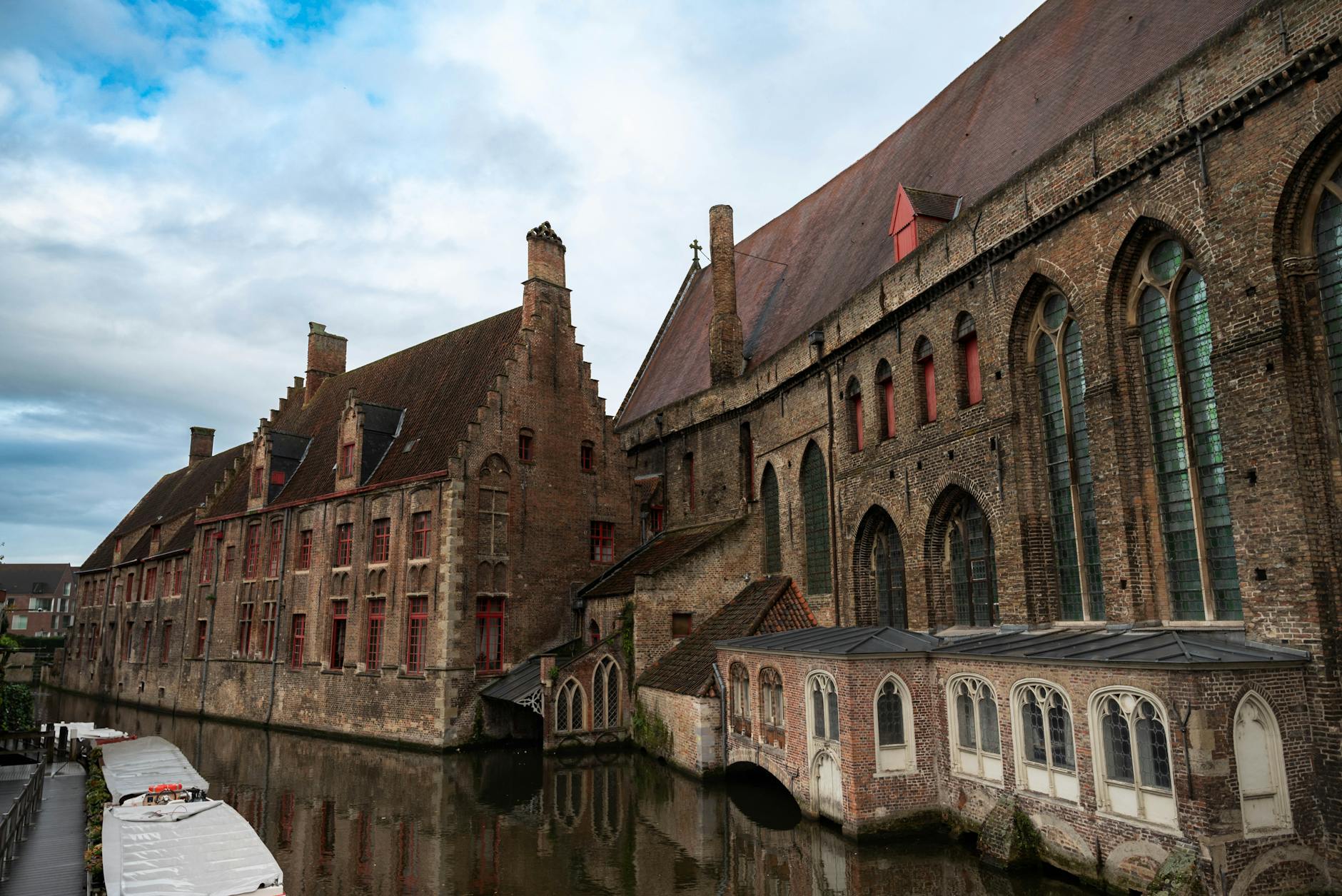
- Bruges is the picture-postcard one: intact medieval centre, canals, the Belfry, the Groeningemuseum and Michelangelo’s Madonna and Child. It is also the most crowded place in Belgium between ten and five. See it early or stay overnight.
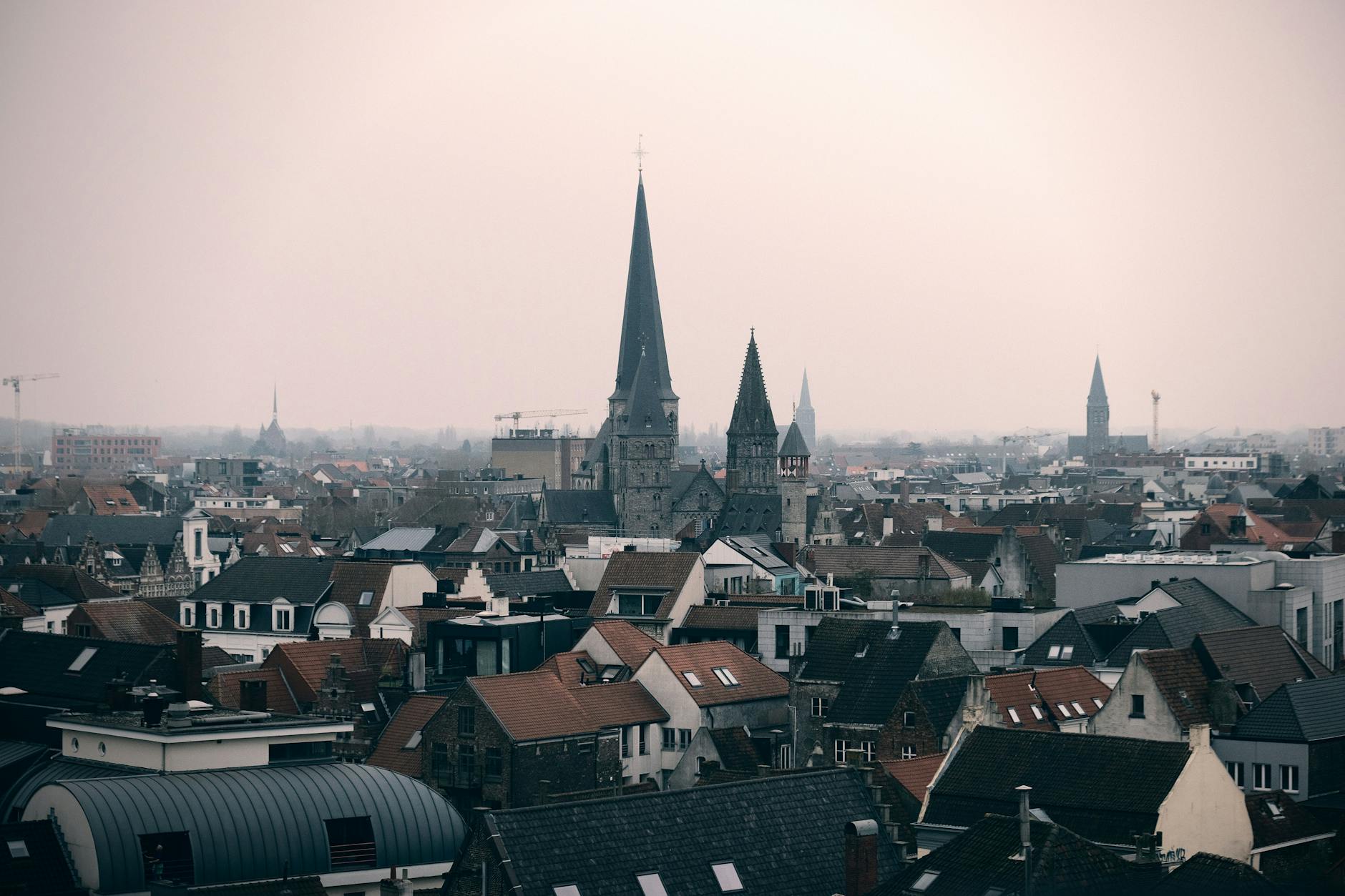
- Ghent is Bruges with a student population and a pulse — the Graslei waterfront, the Van Eyck altarpiece in Saint Bavo’s, a genuinely good bar scene, and far fewer coach parties.
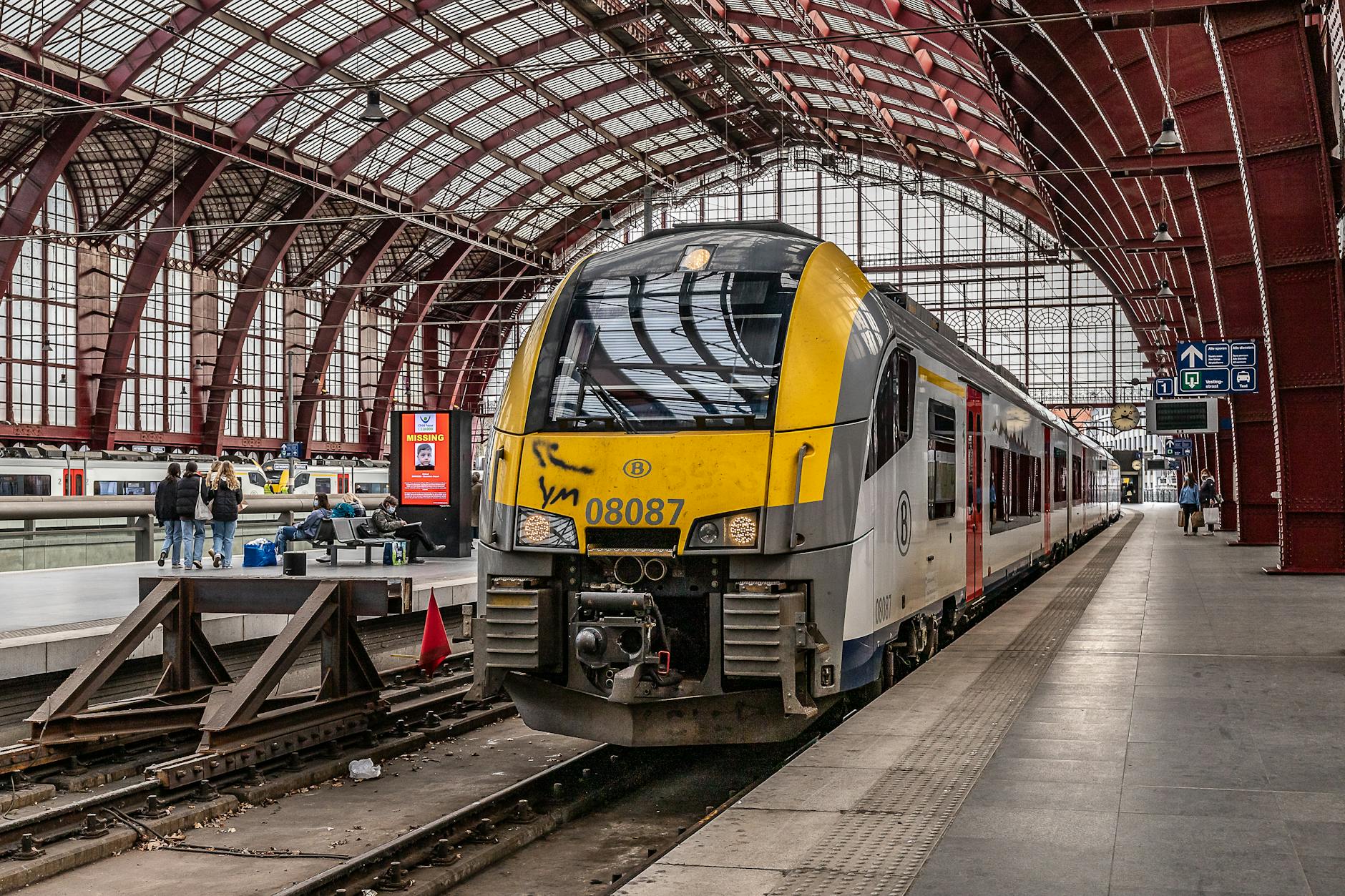
- Antwerp is the big one: a port city with the country’s best fashion and design scene, Rubens everywhere, the diamond quarter, and a railway station that is worth the trip on its own.
- Mechelen is the underrated one — a compact centre, Saint Rumbold’s tower, and Kazerne Dossin, one of the most affecting museums in Belgium.
- Leuven is a university town with the most beautiful town hall in the country and a square that fills with students on a warm evening.
We cover each as a day trip in detail: Bruges, Ghent, Antwerp, Mechelen and Leuven.
The Belgian coast
Sixty-five kilometres of North Sea beach, unbroken, backed almost entirely by apartment blocks. It is not beautiful in the conventional sense and it is very Belgian: families, wind, shrimp croquettes, and an enormous amount of building. Ostend has a proper town behind the seafront and the best museums. Knokke-Heist is where the money goes. De Haan has kept its Belle Époque villas and is the prettiest stop on the line. In August it is packed; in October it is bracing and half empty and rather good.
The Meuse valley
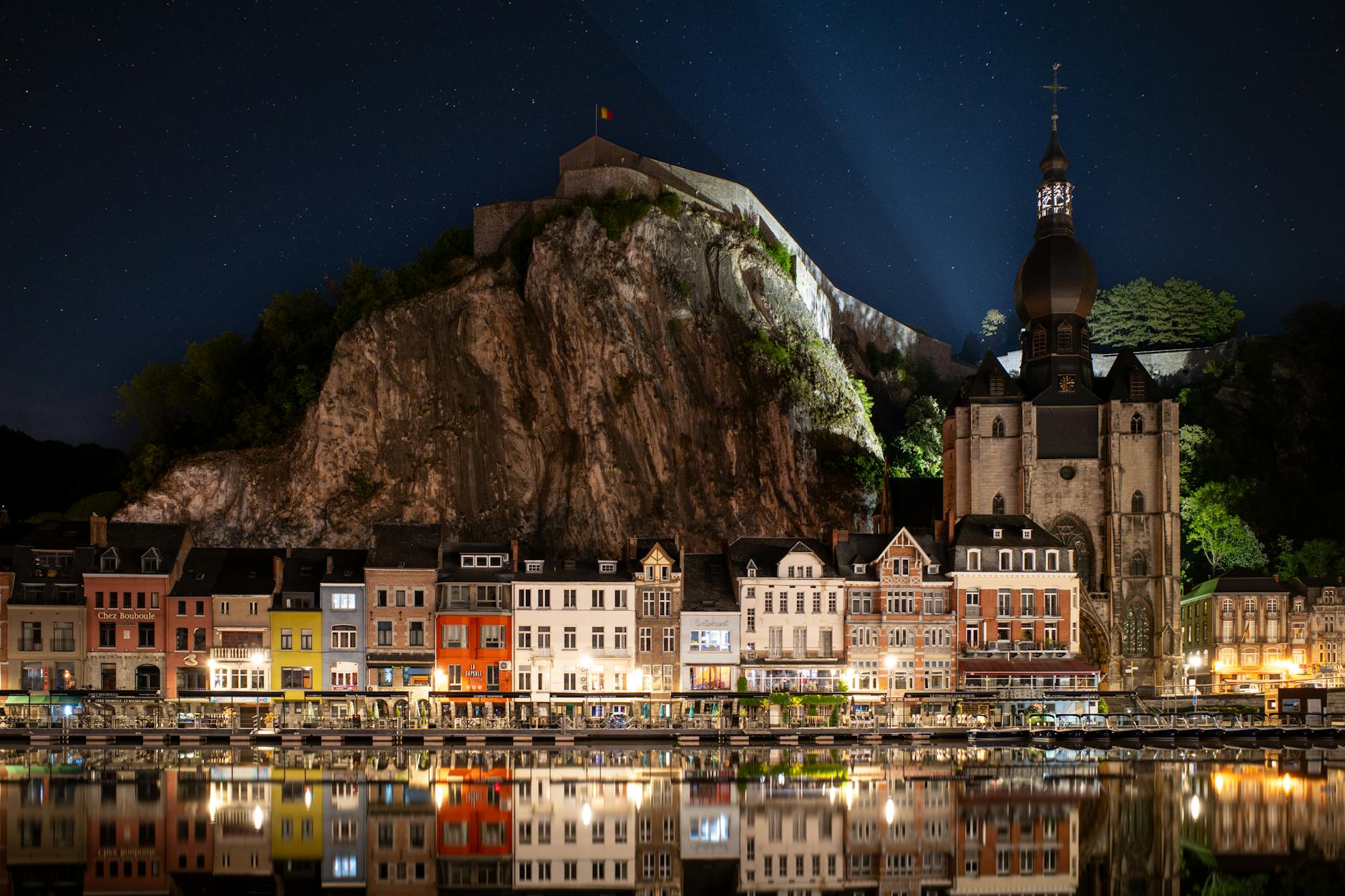
The Meuse cuts a limestone gorge through southern Belgium and gives you the country’s most dramatic scenery within an hour of Brussels. Namur sits at the confluence with the Sambre under an enormous citadel; Dinant is squeezed between the cliff and the river beneath its bulbous collegiate church, and is the birthplace of Adolphe Sax. Our Dinant day trip covers the logistics for a single day.
The Ardennes
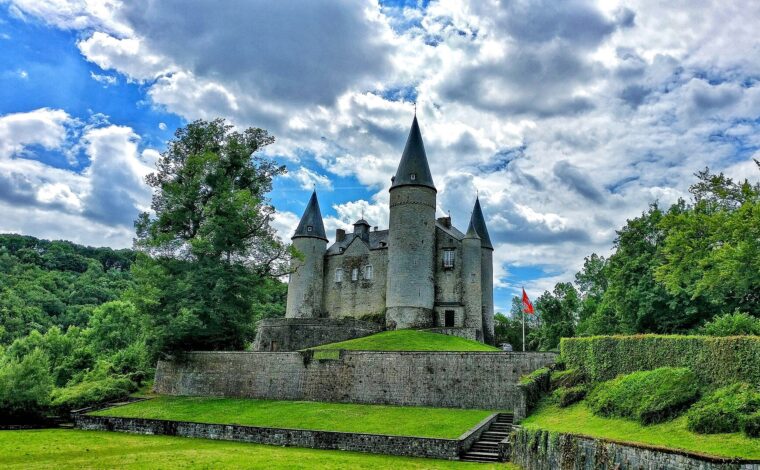
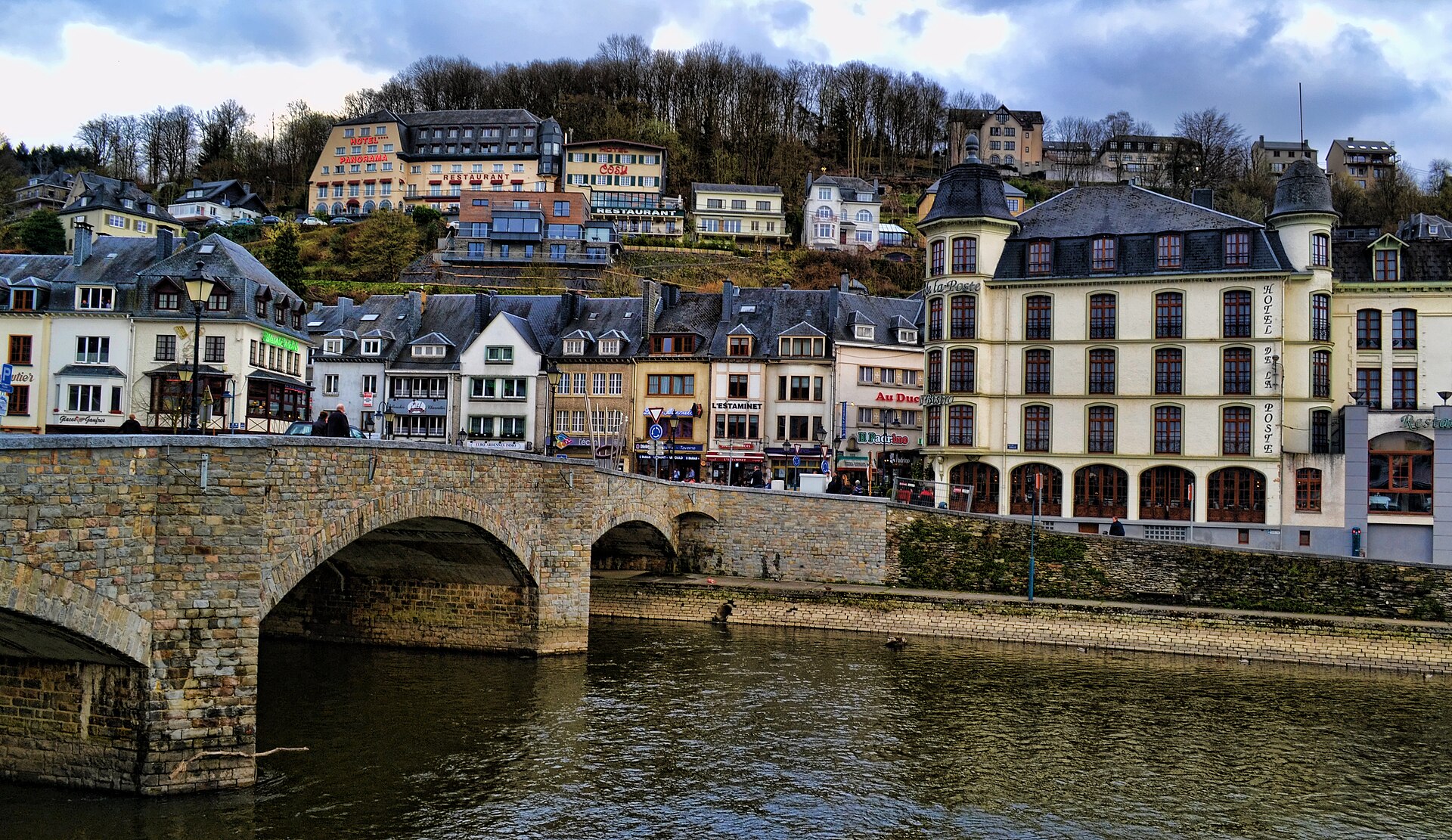
The southeast quarter: forested hills, deep river valleys, castles on rock spurs, and a food culture built on game, trout, ham and abbey beer. Bouillon sits in a loop of the Semois under the castle of Godfrey of Bouillon; Durbuy markets itself as the smallest city in the world; Han-sur-Lesse has one of Europe’s great show caves; Bastogne carries the memory of the Battle of the Bulge.
Be realistic about access. Train reaches the main towns but not the valleys, and bus frequencies are rural. This is the one part of Belgium that genuinely rewards a hire car and an overnight, and treating it as a day trip from Brussels — as our Durbuy day trip page does for one town — gives you a taste rather than the region.
Flanders Fields
The Ypres Salient is the most visited First World War landscape in the world, and rightly. Ypres itself was rebuilt from nothing after 1918; the Menin Gate ceremony has taken place every evening since 1928, apart from the German occupation of 1940-1944, when it was held at Brookwood instead. Tyne Cot is the largest Commonwealth war cemetery anywhere. It is a long day from Brussels and an emotionally heavy one — see our Ypres and Flanders Fields guide — and if this is a priority for your trip, consider staying a night in Ypres.
Closer to Brussels, Waterloo is half an hour south and covers a different war entirely.
How Many Days Do You Need?
The honest bands, assuming a Brussels base and train travel:
- Three days — Brussels itself plus one day trip. Enough to like the country, not enough to know it.
- Five days — Brussels plus three day trips, comfortably. The standard shape, and it works.
- Seven days — the sweet spot. Brussels, the three big Flemish cities, one Walloon day and a spare day for weather or laziness.
- Ten days or more — add the Ardennes or the coast with overnights, and stop treating everything as a return trip from one hotel.
If your question is specifically about the capital rather than the country, how many days you need in Brussels answers that separately.
When to Go
| Season | What it is like | Verdict |
|---|---|---|
| April–June | Mild, long days, bluebells in the beech woods, everything open | Best overall |
| July–August | Warmest, busiest, coast full, city hotels cheaper than you expect | Fine if you book |
| September–October | Quiet, golden, Ardennes at its best | Excellent value |
| November | Grey and wet, museums empty | The weakest month |
| December | Christmas markets everywhere, dark by half past four | Atmospheric, crowded |
| January–March | Cold, cheap, carnival season in February or March | Underrated |
Belgian weather is maritime and unreliable in every month — pack a layer and something waterproof regardless of the forecast. Our guide to the best time to visit and the Brussels weather guide go month by month.
Food and Drink Across Belgium
Belgian food is regional, and treating it as one cuisine misses most of it. Flanders gives you stoofvlees (beef stewed in dark beer), waterzooi from Ghent, North Sea shrimp and mussels. Wallonia leans towards game, trout, Ardennes ham and the Liège meatball. The things everyone knows about — frites, waffles, chocolate — are genuinely as good as claimed, provided you buy them from the right place.
Beer is the national achievement and it is not marketing. Trappist breweries at Westmalle, Chimay, Orval, Rochefort, Westvleteren, Achel and Sint-Bernardus; the lambic and gueuze tradition of the Senne valley around Brussels; hundreds of independent breweries beyond that. Each beer has its own glass and this is taken seriously. Our Belgian beer guide and traditional Belgian dishes pages go deeper.
One national warning: any restaurant with a man outside inviting you in, a laminated photo menu and a display of iced seafood is aimed at people who will never come back. This is true in Brussels, Bruges and Antwerp alike. Walk one street further.
What Things Cost
| Item | Typical 2026–27 price |
|---|---|
| Cone of frites from a friture | €3.50–5 |
| Beer in a café | €3–5 (more for a Trappist) |
| Sit-down lunch | €15–25 |
| Museum admission | €10–15 |
| Rail single, Brussels to Ghent | Priced by distance, under the national cap of about €21 |
| Rail single, longest domestic run | About €21 (the national cap) |
| Mid-range hotel, Brussels | €90–160, cheaper at weekends |
| Mid-range hotel, Bruges in summer | Considerably more |
| Daily budget, mid-range | ~€165 per person |
| Daily budget, backpacker | €50–75 per person |
Practicalities
- Tipping is not expected. Service is included and Belgians round up at most. Do not tip 20%.
- Shops generally close on Sunday outside tourist centres, and many small businesses close on Monday morning too.
- Public holidays: 1 January, Easter Monday, 1 May, Ascension, Whit Monday, 21 July, 15 August, 1 November, 11 November, 25 December. There is no Boxing Day in Belgium — 26 December is a normal trading day, which surprises British visitors every year.
- Cards work almost everywhere, but a few frituren, market stalls and small cafés are still cash-only or have a minimum.
- Plugs are type E, 230V — the French pin-and-socket variant, so a standard European adapter usually works but not always.
- Tap water is safe everywhere. Restaurants will often charge for it anyway, which is normal here and not a scam.
Passes: Which Ones Actually Pay Back
Two passes matter for a Belgium trip and they serve different people.
The Brussels Card covers 49 museums in the capital at €41 for 24 hours, €53 for 48 and €59 for 72, with a €9 public transport add-on. It breaks even at roughly three museums a day, which is a real amount of museum-going. Our Brussels Card guide works through whether it makes sense for your itinerary.
The museumPASSmusees is the national one: around €64.95 for twelve months and more than 260 museums across Belgium, roughly fifty of them in Brussels. If you are touring the country rather than staying in the capital — or if there is any chance you will come back within the year — it undercuts the 72-hour Brussels Card outright. The price is set annually, so check it before you buy.
If you are visiting fewer than three museums a day, neither pass pays back and you should just buy tickets.
What Is Overrated
An honest guide has to include this section.
- Manneken Pis. Small, surrounded, and about ninety seconds of your life. Go, look, move on.
- Bruges between 11:00 and 16:00 in summer. The centre becomes a queue. The same streets at 08:00 are extraordinary.
- Hop-on hop-off buses. Every Belgian city centre worth seeing is small enough to walk. The bus shows you ring roads.
- Airport and station chocolate. Convenient, expensive, and not better. Buy in town.
- Atomium queues in August. The building is magnificent from outside and the interior is a lift and some exhibition space.
- Any restaurant with a tout. Named again because it is the single most reliable way to waste €60 in this country.
A Suggested Shape for a First Week
Not an itinerary — a shape. Adjust freely.
- Days 1–2: Brussels. Grand-Place, the museums on the Mont des Arts, Art Nouveau in Ixelles/Elsene and Saint-Gilles/Sint-Gillis, an evening in Sainte-Catherine.
- Day 3: Ghent. Early train, Saint Bavo’s for the Van Eyck, the Graslei in the late afternoon light.
- Day 4: Antwerp. Central Station, Rubens, the Fashion Museum, dinner in Het Zuid.
- Day 5: Bruges — on the earliest train you can face, out by late afternoon before the coaches leave and the trains fill.
- Day 6: Something Walloon. Namur and the citadel, or Dinant, or the long day to Ypres.
- Day 7: Brussels again, unhurried. The bits you missed, the market at Sainte-Catherine, one last friture.
If you have ten days, put two nights in the Ardennes between days 5 and 6 and hire a car for them.
If the shape sketched above is roughly what you want but you would rather be handed the week day by day, we have written it out in full. Our 7-day Belgium itinerary runs entirely on domestic trains and uses three bases rather than one — Brussels, then Ghent, then Antwerp — which buys you early mornings in Bruges and late evenings on the Graslei that a day trip cannot reach.
The single question people ask most often before booking is how long all of this takes. We have answered it separately and at length: how many days you need in Belgium works through every trip length from a weekend to a fortnight, sets out how many days each region genuinely needs, and explains why extra days are better spent on mornings and evenings than on extra towns.
Of the three big Flemish cities, Antwerp is the one that most rewards giving it more than a day, and the one most likely to surprise anyone who came to Belgium expecting canals. Our Antwerp travel guide covers it properly: the Rubens paintings in the cathedral, Plantin-Moretus, the free MAS rooftop, Het Zuid, and the current state of the Rubenshuis restoration.
Of everything in this guide, the coast is the section most visitors skip and Belgians least understand skipping. It has its own page now: our Belgian coast guide works west to east through De Panne, Oostduinkerke, Ostend, De Haan, Blankenberge and Knokke, with current Kusttram fares, where to base yourself and an honest verdict on the apartment wall along the seafront.
The Ardennes is the section above that most needs its own page, because it is the one part of Belgium a day trip cannot reach. Our Belgian Ardennes guide works through Bouillon and the Semois, La Roche, Bastogne, the Han caves, Orval and the Hautes Fagnes, with a three-day driving route and a straight answer on what is possible by train and bus.
Related Brussels Guides
- Day Trips from Brussels — the eleven routes that work in a single day, with times and fares.
- Brussels Travel Guide — the capital itself, in full.
- How to Get to Brussels — flights, Eurostar and the overland routes into Belgium.
- Brussels to Bruges by Train — the single most-taken domestic journey in the country.
- Belgian Beer Guide — Trappist, lambic, and how to order without embarrassing yourself.
- Brussels Card and Museum Passes — the maths on whether a pass pays back.
- Where to Stay in Brussels — choosing a base that makes the day trips easy.
- Luggage Storage in Brussels — for the days you change base or travel out and back.
Useful Resources
- belgiantrain.be — SNCB/NMBS. Timetables, current fares and discounts. The authority on the post-2025 ticket range.
- visitflanders.com — the Flemish tourist board, strong on the art cities and cycling routes.
- visitwallonia.be — the Walloon equivalent, and the best starting point for the Ardennes and the Meuse.
- delijn.be — Flemish buses and trams, including the Kusttram.
- museumpassmusees.be — the national museum pass, current price and participating museums.
- visit.brussels — the capital’s own tourist board, for events and the Brussels Card.
Frequently Asked Questions
Is Brussels a good base for exploring Belgium?
Yes, for a first trip. Every main railway line in the country runs through the capital, so Ghent, Leuven, Mechelen, Antwerp, Bruges, Namur and Liège are all between twenty-five minutes and an hour away, at least hourly, with no reservations. Hotel rates are also lower than in Bruges or Ghent, and Brussels discounts at weekends because its stock is priced for business travellers. The exceptions are the Ardennes and the coast, which both need overnights.
How many days do you need in Belgium?
Five days covers Brussels plus three day trips comfortably. Seven is the sweet spot: the capital, the three big Flemish cities, one day in Wallonia and a spare day. Three days is enough for Brussels and one trip out. Ten or more lets you add the Ardennes or the coast properly, with overnights rather than long return journeys.
What language do they speak in Belgium?
Dutch in Flanders (the north), French in Wallonia (the south), both officially in Brussels, and German in a small eastern strip. Signage switches entirely when you cross the language border, which is why cities have two names — Gent and Gand, Brugge and Bruges, Antwerpen and Anvers. English is widely spoken, especially in Flanders, and is the safest language to open in as a visitor.
Is the Belgian Rail Pass still sold?
No. Belgian Railways withdrew the Rail Pass and its other ten-journey cards in October 2025 and rebuilt its fare range around distance-based fares, with 30% off at weekends for adults aged 26–64 and 40% off at any time for under-26s and over-65s. Price your specific journeys on belgiantrain.be rather than trusting older advice.
Do I need a car in Belgium?
Not for the cities — the train is faster, cheaper and less stressful, and city-centre parking is expensive. A car earns its keep in two places: the Ardennes, where public transport reaches the towns but not the valleys, and the Flanders Fields battlefields, which are spread across farmland with no useful bus service. A booked tour solves the second without a hire car.
What is the best time of year to visit Belgium?
April to June and September to October. Both give you mild weather, long enough days, open attractions and manageable crowds. July and August are warmest and busiest, particularly on the coast. December brings Christmas markets to every city but also short, dark days. November is the weakest month. Weather is unreliable year-round, so bring layers whenever you come.
Can you see Bruges, Ghent and Antwerp in one trip from Brussels?
Comfortably — that is the classic five-day Belgian trip. All three are within an hour of Brussels by direct train, running at least twice an hour, so each works as a day trip with an early start and an unhurried return. If you want evening atmosphere in Bruges or Ghent rather than daytime crowds, consider one overnight instead of returning every night.
Is Belgium expensive?
Moderately, and less than the Netherlands or France for equivalent quality. Budget around €50–75 a day as a backpacker and around €165 a day mid-range. Food is where Belgium delivers value: a cone of frites is €3.50–5, a good café beer €3–5, and a proper lunch €15–25. Museum admissions cluster around €10–15, and rail fares are low by western European standards.
Photo Credits
-
The Kusttram on the Belgian coast: Kusttram R01 by Marc Ryckaert, CC BY 3.0, via Wikimedia Commons.
-
Bouillon on the Semois: City Of Bouillon 2 (Belgium) by Isai Symens, CC BY-SA 4.0, via Wikimedia Commons.
Final Thoughts
Belgium is a country that rewards not rushing, which sounds like a platitude until you realise how easy it is to treat it as a checklist of art cities reachable in under an hour. The trains are so good that you can see four towns in four days and come home having experienced none of them properly. The better trip picks fewer places, arrives early, stays for the evening, and accepts that the Ardennes and the coast are separate journeys rather than extensions of a Brussels itinerary.
Base yourself in the capital, take the weekend discount on the longer train runs, learn the difference between Flanders and Wallonia before you get on the first train, and eat where the queue is local. That is most of what a first trip needs. The rest of this site fills in the detail, starting with our day trips from Brussels and working outwards.